
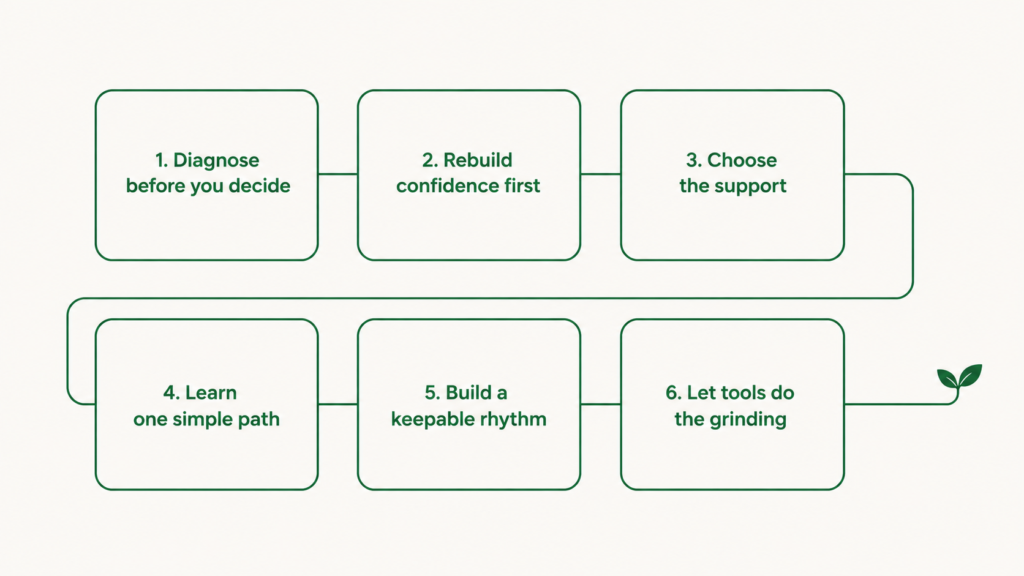
To restart network marketing the right way, work in this order: first understand what actually failed, then rebuild your confidence, then choose your next company based on the support behind it rather than the product or the pay plan. After that, learn one simple path you can hand to a beginner, commit to a weekly rhythm you can keep for a year, and let tools handle the repetitive work so your time goes to people. Restarting the right way is slower at the start and far more durable than starting over the way most people do.
That is the short answer. The rest of this article is the long one — the six steps in detail, the four things that quietly ruin a restart, and how to tell whether you are actually ready.
Nobody Restarts Because They Are Excited
You are probably not reading this because you found a new opportunity.
You are reading it because something in you never fully let go.
You gave this industry real years. You went to the events. You made the calls. You believed in what you were sharing, and you were not wrong to believe.
And then it did not work.
Maybe your company closed its doors. Maybe your upline was a lovely person who was never actually there. Maybe you just worked, and worked, and one day looked at how little had changed and quietly stopped.
Now there is this strange feeling. Part of you is done with it forever. Another part still watches the industry from a distance and thinks, it could have worked, if only.
That second part is not stupidity. That is instinct, and it is usually right about the model and wrong only about the conditions.
So before anything else: none of what happened means you are bad at this.
It means you were building under conditions that almost nobody succeeds under.
First, Separate The Three Things That Can Fail
Most people who restart badly do it because they never worked out what broke last time. So they change the wrong variable, usually the product, and get the same result with a nicer catalogue.
Three things can fail. Only one of them is you, and it is almost never the one people blame themselves for.
1. The company. Its finances, its leadership, its decisions. You did not control any of this, and you could not have.
2. The structure around you. Whether anyone above you actually helped. Whether there was a written path a new person could follow. Whether you ever presented alongside someone experienced, or always alone.
3. Your own effort and consistency. Whether you showed up, learned, and kept going.
Now be honest with yourself about which one gave way.
In my experience talking to people in this industry, item 3 is almost never the problem. The people who reach out to me are exhausted precisely because they did the work. What was missing was item 2 — and item 2 is the one thing everybody forgets to check before joining somewhere new.
Write your answer down. One paragraph is enough. That paragraph becomes the filter for every decision below.
The Six Steps To Restart The Right Way
Do them in this order. The order is the whole method — most people start at step 3 and wonder why it feels the same as last time.
Step 1 — Diagnose before you decide
Answer four questions on paper before you look at a single opportunity:
- What did I actually get good at last time?
- What did I never get help with?
- Which part made me want to quit?
- What would I refuse to repeat?
Keep this page. It is not a journal exercise. It is a specification. Anything you consider next has to answer all four, or it is the same building under a different roof.
Step 2 — Rebuild your confidence before you rebuild your business
This is the step everyone skips, and skipping it is why so many restarts collapse in week three.
If your last experience ended badly, you are carrying something heavier than a lack of strategy. You are carrying the fear of being seen trying again and failing again in front of the same people.
You cannot outwork that. You have to reduce it.
The way to reduce it is small and unglamorous: go and have ordinary conversations with people, with nothing to sell. Reconnect with ten people you lost touch with while you were busy chasing. Ask about their lives. Do not mention business at all.
Two things happen. You find out your relationships survived better than you feared. And you remember that the part of this business you were always good at — talking to people — is still completely intact.
Give this two weeks. It is not a delay. It is the foundation.
Step 3 — Choose the support, not the opportunity
When you do look, change what you evaluate.
Almost everyone evaluates the product and the compensation plan. Those are the two easiest things in the world to make look brilliant in a presentation, and they are not what determined your last outcome.
Evaluate the person and the structure behind them. Ask these out loud, and watch how comfortable they are answering:
- Who exactly would be my upline, and what would they personally do for me? Not “we have great training.” A name, and a specific list of actions.
- Will they meet my prospects with me, or do I present alone? This single question separates most opportunities from most systems.
- Is there a written, step-by-step path I can hand to a brand-new person on their first day? If the answer is a folder of motivational videos, that is not a path.
- What happens in week three, when I am not excited anymore?
- How many companies has this person moved through, and why?
A good answer sounds boring and specific. A weak answer sounds exciting and vague. After twenty-two years, that is the most reliable signal I know.
I wrote about this in more detail in why network marketers fail without upline support — the short version is that the support is not a bonus feature on top of the business. It is the business.
Step 4 — Learn one simple path, then refuse to complicate it
A restart fails quietly when you rebuild the same complexity you burned out on.
The test for whether something is duplicatable is not whether you can do it. You are experienced. The test is whether someone who has never done this in their life can copy it in their first week, and then teach it to the next person without you in the room.
So when you find a path, learn it exactly as written. Do not improve it in month one. Do not add your own three extra steps because you know better. You probably do know better in some small way, and adding it makes the path unteachable, which costs far more than the improvement gains.
Simple survives being passed down. Clever does not.
Step 5 — Build a rhythm you could keep for a year
Ask yourself an uncomfortable question: could I do this every week for twelve months, in a bad week, when I am tired, when nothing is working yet?
If the honest answer is no, the plan is too big. Cut it in half and ask again.
A rhythm that survives a bad month beats an intense plan that dies in six weeks. This is what a keepable week looks like at the start:
| When | What |
|---|---|
| Once a week | Join the live team training — bring a guest if you have one, come alone if you do not |
| Twice a week | One genuine conversation with someone new. Not a pitch. A conversation. |
| Once a week | Follow up with people who asked you to check back |
| Once a week | Publish one honest piece of content — your story, or something you learned |
| Once a month | Look at what actually happened, and change one thing |
That is a few hours a week. It is deliberately unimpressive. Unimpressive is what you can still be doing in March.
Step 6 — Let tools do the grinding, so you do the relationships
This part did not exist the last time most people tried.
The genuinely tedious parts of building — writing posts, drafting follow-up messages, turning one story into a week of content, organising your notes — are now things AI tools can carry most of the way. Not the conversations. The paperwork around the conversations.
I use AI to turn one article into a week of posts across five platforms. The thinking and the stories are mine. The formatting, the rewriting, and the repetition are not.
Be careful about one thing: do not let a tool speak for you. The reason people reply to you is that you sound like a real person who has actually lived this. Use AI to remove the grind, never to replace your voice.
What Restarting The Right Way Is Not
Four things get mistaken for a restart. All four feel like progress, and none of them are.
It is not finding a hotter product. If support was the missing piece, a better product changes nothing. You will just be alone with a nicer bottle.
It is not getting in early. Ground-floor timing sounds like an advantage and is mostly a risk transfer. New companies fail more often than established ones, and being first in the door does not put anyone beside you when you are stuck.
It is not working harder than last time. You already tried the hardest-working version of yourself. It did not fail from lack of effort. Repeating it with more intensity is not a new plan.
It is not rejoining quietly to avoid a conversation. If you are restarting mainly so nobody notices you left, the thing you actually need is not a business. It is honesty with a few people, first.
I Restarted After Twenty-One Years. Here Is What Changed.
My name is Lili Budiman. I started in network marketing in May 2004, after attending a seminar called “The Internet Money Machine.” I did not even know it was network marketing when I signed up.
My wife Angela and I saw the products make a difference for people across Taiwan, Indonesia, Malaysia, Singapore, New Zealand and the US. We believed in what we were doing. A few years in, I resigned from my job as a lecturer to build the business full-time.
Then came twenty-one years of almost nothing.
People bought products. But the business barely moved. No new signups for years at a stretch. We worked hard, and we had very little to show for it.
My company never closed. And still, I know what you are feeling, because the outcome was the same: two decades of effort, and a business that did not exist in any real sense.
Here is what took me that long to understand. I was not without an upline. I was without upline support. My upline was a decent man who was busy and still figuring it out himself. So I did all of it alone — prospecting, presenting, handling objections, following up, training — for twenty-one years.
What changed was not motivation, and it was not a better product.
It was structure.
I began working with Dave Daughtrey, who has twenty-eight years in this industry and builds on one line: “the upline serves the downline.” Every week, my guests and I join a live Zoom where Dave does the training and shows the full picture. In San Diego, he meets people over coffee, face to face, with no pitch.
My job became simple: invite, and let the system carry the weight.
I stopped presenting alone. I stopped guessing. I stopped feeling alone.
That is the whole difference between my first twenty-one years and now. Same industry. Same person. Different structure.

You Are Not Starting From Zero
Read this part slowly, because it is the part you will want to skip.
Someone who has been through a failed run in this industry is not a beginner. They are an experienced person with an expensive education.
You know how to talk to people about something you believe in.
You know how it feels to be let down, which makes you incapable of doing it to someone else.
You can tell the difference between a real system and a hype video, usually within about five minutes.
You can spot a leader who serves and a leader who performs.
You already know that this business is slower and more human than the presentations suggest — which means you will not quit in month two when it turns out to be exactly that.
None of that is on a beginner’s résumé. You paid for all of it. The only question is whether you use it or throw it away.
An Honest Word Before You Go Further
If what you are looking for is the next hot opportunity, a ground-floor launch, or a promise that this time it will be fast — we are not the right fit, and I would rather say that now than waste your time.
There are no income guarantees here. There is no claim that any product cures anything. Building this way is slower at the start, because relationships move slower than hype.
But if you are tired, still quietly believe in this industry, and mostly want to know that someone will actually be there when you need help — then this was built for people like you.
Frequently Asked Questions
Is it worth restarting network marketing after failing?
That depends entirely on what failed. If you never had real support, a written path, or anyone to present alongside you, then you have not really tested the model yet — you tested doing it alone, and that almost never works. If those three things are genuinely in place next time, it is a different experience.
How do I know whether it was the company or me?
Ask what specifically you were given. If nobody trained you, nobody presented with you, and there was no step-by-step path a beginner could follow, the honest answer is that the conditions failed, not you. Effort without structure looks exactly like failure from the outside.
Should I go back to the same company I left?
Sometimes, yes — if the reason you struggled was the support around you rather than the company itself, and you now have a different upline. Check your old agreement first, because re-entry terms and non-solicitation clauses vary. I am not a lawyer, so if the wording is unclear, ask one.
What do I say to people who watched me fail last time?
Say the true thing, briefly. Something like: “I tried this before without much help and it didn’t work. I’m doing it differently now.” People respect that far more than a triumphant announcement. The ones who care about you were never keeping score anyway.
How long does a restart take before it feels real?
There is no timeline anyone can honestly promise you, and be careful with anyone who offers one. What I can say is that the first thing to return is not results — it is the feeling of not being alone in it. For most people I talk to, that changes within the first few weeks, and it is what makes the slower part bearable.
Am I too old, or too far behind, to start again?
The people who restart with the most credibility are usually the ones who have been through the most. In a business built on trust, having been let down and staying decent about it is an advantage, not a disadvantage.
If You Want To Talk It Through
You do not need to decide anything today.
But if it would help to talk to someone who has been in this industry for twenty-two years, spent twenty-one of them stuck, and has no interest in rushing you — message me.
Tell me a little about your story. What company, how long, and what you are thinking now. If I can help, I will. If this is not the right path for you, I will tell you that too.
📍 In San Diego? We also do this the old-fashioned way — a relaxed, one-on-one coffee chat with Dave. No pitch, no pressure. Learn more about coffee chats →
🌱 Or start here: Restart Network Marketing
[…] of this — the whole sequence for coming back to this industry properly — I wrote it here: how to restart network marketing the right way. And if what you are recognising is that you never had anybody above you doing the presenting at […]
[…] you want the longer version of how that rebuild works, it is here: how to restart network marketing the right way. And if what you are really carrying is the effect of building with no support at all, that is this […]