
If your network marketing company closed, the most important thing to do first is nothing permanent. Take 30 days to separate what actually failed — the company — from what did not fail: your skills, your relationships, and your willingness to work. Then choose your next step based on the support system behind the company, not the excitement of a new launch.
That is the short answer. The rest of this article is the part nobody tells you: what to save before the back office goes dark, what to say to your team, and how to know whether you are ready to start again.
First, Let’s Name What Actually Happened
An email arrived, or a Zoom call was scheduled at an odd hour.
And in a few minutes, something you built for years stopped existing.
Not slowed down. Not paused. Gone.
The back office. The commission schedule. The convention you already booked a flight for. The team group chat that suddenly has nothing to organize around.
If you feel like you are grieving, that is because you are. You lost a business, an identity, and a plan for your future on the same day. People around you may not understand why it hurts so much. “It was just a side thing,” they say. It was not just a side thing. You gave it real years.
So before any advice: none of it was your fault.
You did not close the company. You did not set its margins, choose its leadership, or approve its decisions. You did the one part that was yours to do — you talked to people, you served customers, you showed up.
That part still works. It is still yours.
The First 30 Days: A Simple Checklist
Do these in order. Most of them take less than an hour.
- Export everything while you still can.
Back offices are usually switched off within weeks. Log in today and save your customer list, your team list, your order history, and any contact details you have. Put it in one spreadsheet. This is the single most valuable asset you own, and it is the one most people lose. - Read your agreement before you talk to anyone.
Most distributor agreements contain a non-solicitation clause, and some clauses survive after the company closes. This matters if you plan to invite former teammates anywhere. Read it, and if the wording is unclear, ask a lawyer. I am not one. - Tell your team the truth, early.
You do not need a polished announcement. You need an honest one. Something like: “The company has closed. I don’t have all the answers yet. I’m taking some time to think about what’s next, and I’ll keep you updated.” People forgive uncertainty. They do not forgive silence. - Take care of your customers.
If people were using and enjoying the products, they deserve to hear it from you rather than discover it when their reorder fails. A short, personal message protects the relationship — and the relationship is what carries forward, not the product code. - Write down what you learned.
While it is fresh, answer three questions on paper: What did I actually get good at? What did I never get support with? What would I refuse to repeat? Keep this. It becomes your filter later. - Do not sign anything for 30 days.
This is the hard one. Within days of a company closing, recruiters arrive. They are kind, they are urgent, and they have a “ground floor” to offer you. Some are genuinely good people. But a decision made from panic is rarely a good decision, and 30 days costs you nothing.
I Didn’t Lose a Company. I Lost 21 Years.
My name is Lili Budiman. I started in network marketing in May 2004, after attending a seminar called “The Internet Money Machine.” I did not even know it was network marketing when I signed up.
My wife Angela and I saw the products make a difference for people across Taiwan, Indonesia, Malaysia, Singapore, New Zealand and the US. We believed. A few years in, I resigned from my job as a lecturer to build the business full-time.
Then came 21 years of almost nothing.
People bought products. But the business barely moved. No new signups for years. We worked hard and had very little to show for it.
My company never closed. And yet I know exactly what you are feeling right now — because the outcome was the same. Years of effort, and a business that did not exist in any real sense.
Here is what took me two decades to understand: the problem was never the industry, and it was never my effort. I was building alone. I believed in the products, but nobody ever showed me how to share them. My upline was busy, still figuring it out themselves.
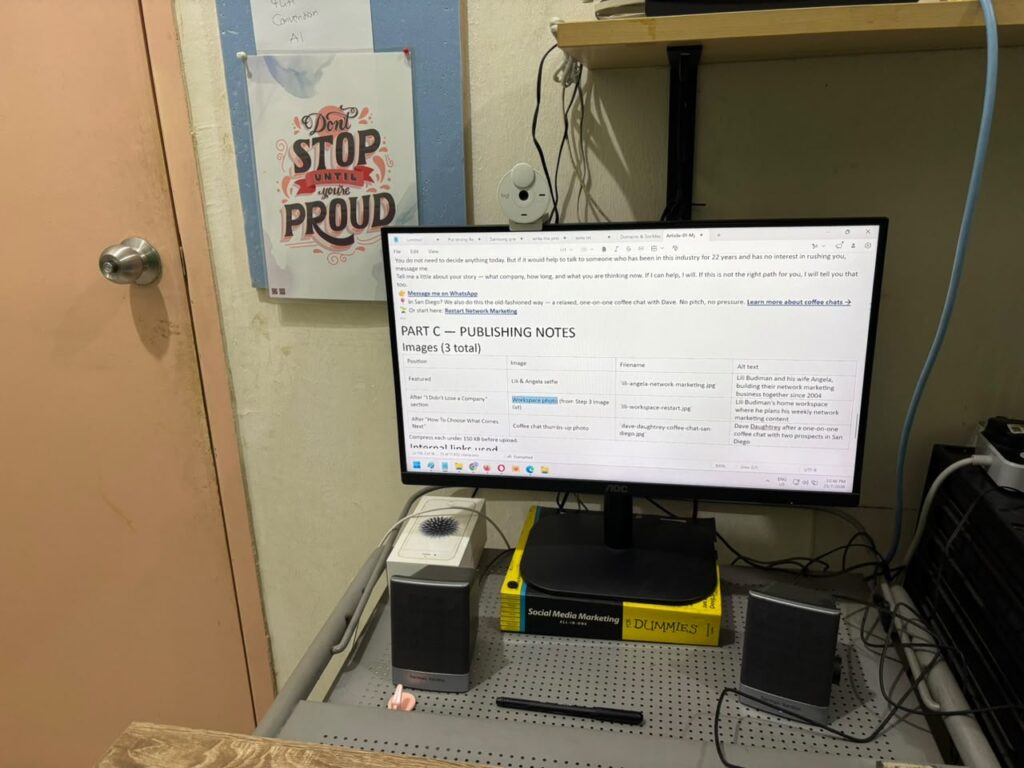
That was the missing piece. Not motivation. Not a better product. Support.
You Still Have Something Valuable To Offer
Read this part slowly, because it is the part you will be tempted to skip.
You survived a company closing. That means you already know something most new recruits will not learn for years.
You know how to talk to people about something you believe in.
You know what it feels like to be let down, which makes you incapable of doing it to someone else.
You know the difference between a real system and a hype video.
You can spot a leader who serves and a leader who performs.
That is not a beginner’s résumé. That is experience. Painful experience, but experience.
The industry did not disqualify you. It gave you a very expensive education. The only question now is whether you use it or throw it away.
How To Choose What Comes Next
If and when you do look at another company, change what you evaluate. Most people evaluate the product and the compensation plan. Those are the easiest things to make look good in a presentation.
Evaluate the support instead. Ask these questions out loud, and watch how comfortable the person is answering them:
Who exactly would be my upline, and what would they actually do for me? Not “we have great training.” Who, and what specifically.
Will they meet my prospects with me, or do I present alone? This one question separates most opportunities from most systems.
Is there a written, step-by-step path I can hand to a brand-new person? If the answer is a folder of motivational videos, that is not a system.
What happens in week three, when I am not excited anymore?
How long has this person been in the industry, and how many companies have they moved through?
A good answer sounds boring and specific. A weak answer sounds exciting and vague.
For me, the answer arrived in the form of a person: Dave Daughtrey, 28 years in this industry, built on one line — “the upline serves the downline.” Every week, my guests and I plug into a live Zoom where Dave does the training and shares the full picture. My job became simple: invite, and let the system carry the weight. I stopped presenting alone. I stopped guessing. I stopped feeling alone.

That is the whole difference. Not a better product. A better structure.
An Honest Word Before You Go Any Further
If what you want right now is the next hot opportunity, a ground-floor launch, or a promise that this time it will be fast — we are not the right fit, and I would rather say that now than waste your time.
There are no income guarantees here. There is no claim that any product cures anything. Building this way is slower at the start, because relationships are slower than hype.
But if you are tired, still quietly believe in this industry, and mostly want to know that someone will actually be there when you need help — then you might be exactly the kind of person this was built for.
Can I bring my old downline with me to a new company?
It depends entirely on your distributor agreement, and some non-solicitation clauses remain in force even after a company closes. Read your agreement first, and if the wording is unclear, get proper legal advice before you contact anyone. Staying in touch as friends is different from recruiting — know which one you are doing.
How long should I wait before joining another company?
There is no rule, but 30 days is a useful minimum. It is long enough for the panic to pass and for the fastest-moving recruiters to move on, which makes it much easier to see an opportunity clearly.
Is network marketing itself the problem?
For most people I talk to, no. The common failure is not the model — it is building without support, without a duplicatable system, and without anyone to present alongside you. Change those three things and the experience is genuinely different.
I feel embarrassed to face my team. What do I say?
Say the true thing, briefly, and early. You did not close the company, and your team knows that better than you think. In my experience, the relationships that survive a closure are the ones where the leader kept talking, and the ones that die are the ones where the leader disappeared.
Am I too old, or too far behind, to start again?
The people who restart with the most credibility are usually the ones who have been through the most. Experience is not a disadvantage in a business built on trust.
The people who restart with the most credibility are usually the ones who have been through the most. Experience is not a disadvantage in a business built on trust.
If You Want To Talk It Through
You do not need to decide anything today. But if it would help to talk to someone who has been in this industry for 22 years and has no interest in rushing you, message me.
Tell me a little about your story — what company, how long, and what you are thinking now. If I can help, I will. If this is not the right path for you, I will tell you that too.
👉 Message me on WhatsApp
📍 In San Diego? We also do this the old-fashioned way — a relaxed, one-on-one coffee chat with Dave. No pitch, no pressure. Learn more about coffee chats →
🌱 Or start here: Restart Network Marketing