
Duplication in network marketing means copying a process, not copying a person. It is only real duplication when a brand-new person can do the first step in their first week without you standing beside them, and then teach that same step to someone else without you in the room. Anything that depends on your confidence, your years of product knowledge, or your ability to present well is not duplication — it is performance, and performance stops with you.
That is the short answer. The rest of this article is the test I wish someone had handed me twenty years ago: how to tell in five minutes whether a system actually duplicates, and why so many hard-working people were told to duplicate something that was never copyable in the first place.
You Were Told To Duplicate. Nobody Told You What To Copy.
“Just duplicate what I do.”
You heard it at every meeting.
You nodded, because it sounded simple.
Then you went home and tried to work out what “what I do” actually was.
Was it the way he opened the conversation? The story he told at minute six? The confidence he had, and you did not?
So you watched the replay again. You took notes. You practised in the car.
And the next time you sat in front of a real person, none of it came out the way it did on stage.
You assumed the problem was you. Everybody else seemed to manage.
Here is the part nobody said out loud.
You were asked to copy something that was never copyable.
The Simplest Definition I Know
Duplication is not copying a person. It is copying a process.
And a process only counts as duplicable if it passes two halves of one test:
- A brand-new person can do it without you. Not after six months of training. In their first week, on their own, without your voice in their ear.
- That same person can teach it to somebody else without you. In three sentences. Over the phone. Badly, and it still works.
Most of what gets called duplication passes the first half and fails the second. Someone copies what you did — but they cannot pass it on, because the only reason it worked was that you were there.
That is not duplication. That is a favour you did for one person.
The Third-Generation Test
Here is the fastest way to check whether anything actually duplicates.
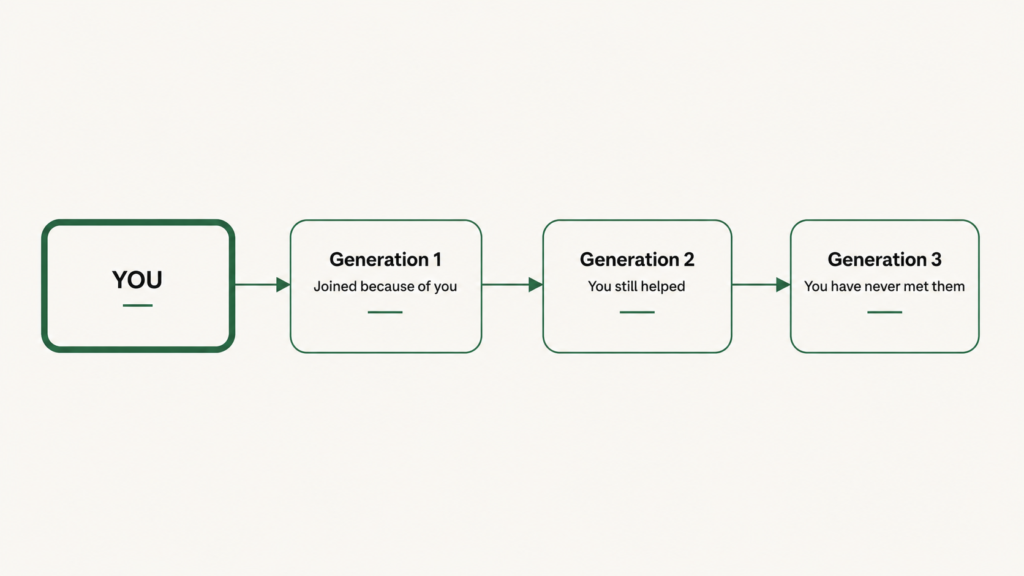
Count three generations down.
- Generation 1 is the person you personally brought in. They joined because of you. They have your phone number. Of course it works.
- Generation 2 is the person they brought in. You probably helped. You joined the call, you answered the question, you smoothed the awkward moment.
- Generation 3 is the person that person brought in. You have never met them. They do not know your name. You were not on the call.
If the process still works at generation 3, it duplicates. If it dies before it gets there, it was never a system — it was you.
This is the uncomfortable part. A team can look busy and growing at generation 1, because the leader is doing all the real work by hand. It only shows up as a problem at generation 3, when the leader runs out of hours and the whole thing quietly stops.
Twenty-one years taught me that lesson slowly and expensively. You can have it in one paragraph.
What Duplicates, And What Never Will
There is one rule that sorts almost everything:
If it took you years to get good at, it does not duplicate.
Here is the honest split.
Things that never duplicate:
- Your confidence
- Your years of product knowledge
- Your ability to hold a room for forty-five minutes
- Your personal network, and how long you have known them
- Your tolerance for rejection
- Your willingness to be on the phone at eleven at night
- Your story
Things that duplicate:
- One invitation, said the same way every time
- One link
- One weekly meeting that somebody else runs
- One written path with numbered steps
- One question you ask everybody, in the same words
- One honest sentence you are happy for a nervous beginner to repeat
Notice what the second list has in common. Every item is small, boring, and requires no talent.
That is not a weakness of the list. That is the entire point. A system that needs talent is not a system. It is an audition.
I Spent 21 Years Trying To Duplicate The Wrong Thing
My name is Lili Budiman. I started in network marketing in May 2004, after attending a seminar called “The Internet Money Machine.” I did not even know it was network marketing when I signed up.
My wife Angela and I believed in what we were sharing. People bought. But the business barely moved — no new signups, for years.
And I honestly thought my problem was duplication. I read about it. I taught it. I could define it.
What I could not do was hand anybody a copy of what I was actually doing, because what I was actually doing was improvising.
Every conversation was different. Every explanation came out a slightly different length. Some weeks I sounded confident and some weeks I did not. I was not running a process. I was performing a version of myself, and I could not even duplicate that reliably for me.
You cannot duplicate improvisation. That was the whole thing. It took me two decades to see it.
What changed was not effort and not a better product. It was structure. I now have an upline, Dave Daughtrey, with 28 years in this industry and one line he builds everything on: “the upline serves the downline.” Every week, my guests and I join a live Zoom where Dave does the training and shares the full picture.
Which means my job shrank to one action: invite.
That is a job a nervous person can do in week one. It is a job I can explain in three sentences. It is a job that does not need me to be having a good day.
A few weeks ago, somebody joined our team after finding one of these articles. Not a crowd. One person. But here is what mattered to me more than the signup: in their first week I gave them one action, not the whole system — because whatever I do with them is the thing they will copy with their first person.
That is when I finally understood that duplication is not something you teach. It is something you demonstrate, and then get out of the way.

You Are Not Bad At Duplicating
Read this part slowly.
If you have ever been told your team “just won’t duplicate,” there is a very good chance nothing was wrong with you or with them.
You were handed an unrepeatable job and told to repeat it.
You watched a leader do something that took them fifteen years to become good at, and you were told it was simple. When it did not work, the explanation was always about you — your belief, your mindset, your consistency.
That explanation is convenient, and it is usually wrong.
Here is what your effort actually proves. You kept trying a method that was never going to travel. Most people quit that long before you did. The persistence was real, even though the process was not.
And the good news inside that is genuinely good: a broken process can be replaced. A broken person cannot. You were never the broken part.
How To Test A System Before You Build On It
The next time somebody shows you an opportunity, do not evaluate the product or the pay plan first. Those are the two easiest things to make look impressive in a slide.
Test the duplication instead. Four questions, asked out loud:
- What is the first action a brand-new person does, in week one? If the answer is a list of things, it is not a system. A system has one first step.
- Can that person do it without you in the room? Ask them to describe the exact moment when the new person is alone. If they cannot picture it, it has not happened yet.
- Can a shy, busy, not-very-confident person do it? Not the best recruit. The most ordinary one. Systems that only work for naturals are not systems.
- Show me generation three. Ask to be introduced to somebody in their organisation they have never personally met, who is doing the thing. This is the question almost nobody asks, and it is the one that tells the truth.
A strong answer to these sounds boring and specific. A weak answer sounds exciting and vague.
If you want the wider version of this — the whole sequence for coming back to this industry properly — I wrote it here: how to restart network marketing the right way. And if what you are recognising is that you never had anybody above you doing the presenting at all, that is a different problem with a different fix: why network marketers fail without upline support.
An Honest Word Before You Go Any Further
Duplication is boring.
It is one small action, repeated, on a schedule, for a long time, mostly with no applause. There is nothing clever in it, and nothing that would make a good video.
Simple is also not the same as easy. Doing one plain thing every week for a year is harder than doing ten exciting things for a month.
So if what you want is speed, a ground-floor launch, or a promise that this time it will be different because the timing is right — we are not the right fit, and I would rather say it now than waste your time. There are no income guarantees here, and no claim that any product cures anything.
But if you are tired of building something only you can operate, and what you actually want is a process a normal person could copy — then this is the part of the business worth getting right.
Frequently Asked Questions
Isn’t duplication just copying somebody?
Copying a person almost never works, because most of what makes them effective is invisible and took them years to build. Duplication copies the process instead — the exact first action, the exact invitation, the exact meeting — so the result does not depend on being like them.
How simple does a system have to be?
A useful benchmark: a brand-new person should be able to explain their first step to a friend in three sentences, and take that step within seven days without training. If it needs a course before anybody can start, it will lose most people before they ever begin.
My team won’t duplicate. What am I doing wrong?
Usually one of two things. Either the system has too many steps, so people freeze at the start — or they watched you do something they know they cannot copy, and quietly decided the business requires a version of you. Shrink the first step until it feels almost too small, and do that step in front of them rather than describing it.
Does using AI break duplication?
Only if it becomes a requirement. AI is excellent at removing the repetitive parts of marketing, and I use it every week. But the moment your team believes they need to be good with AI in order to build, you have added a barrier and lost the beginners. Keep it clearly optional — a tool that makes the work lighter, never a skill anybody has to pass.
If You Want To Talk It Through
You do not need to decide anything today. But if it would help to talk to someone who spent 21 years trying to duplicate the wrong thing, and has no interest in rushing you, message me.
Tell me a little about your story — what you built, how long, and what made you step away. If I can help, I will. If this is not the right path for you, I will tell you that too.
📍 In San Diego? We also do this the old-fashioned way — a relaxed, one-on-one coffee chat with Dave. No pitch, no pressure. Learn more about coffee chats →
🌱 Or start here: Restart Network Marketing
[…] I talk to, no. The common failure is not the model — it is building without support, without a duplicatable system, and without anyone to present alongside you. Change those three things and the experience is […]
[…] test for whether something is duplicatable is not whether you can do it. You are experienced. The test is whether someone who has never done […]
[…] A folder of videos is not a system. A group chat with four years of scrolled-past screenshots is not a system. A system is a numbered path, where step one is small enough to do this week and step two only makes sense after step one is done. If nobody could tell you what to do first, there was never a first. There was only a pile. (I wrote about what real duplication looks like in what is duplication in network marketing, really.) […]
[…] That is the part that matters most to me. AI made my marketing duplicatable. (If you want the full picture on why that word matters, read What Is Duplication In Network Marketing, Really?) […]